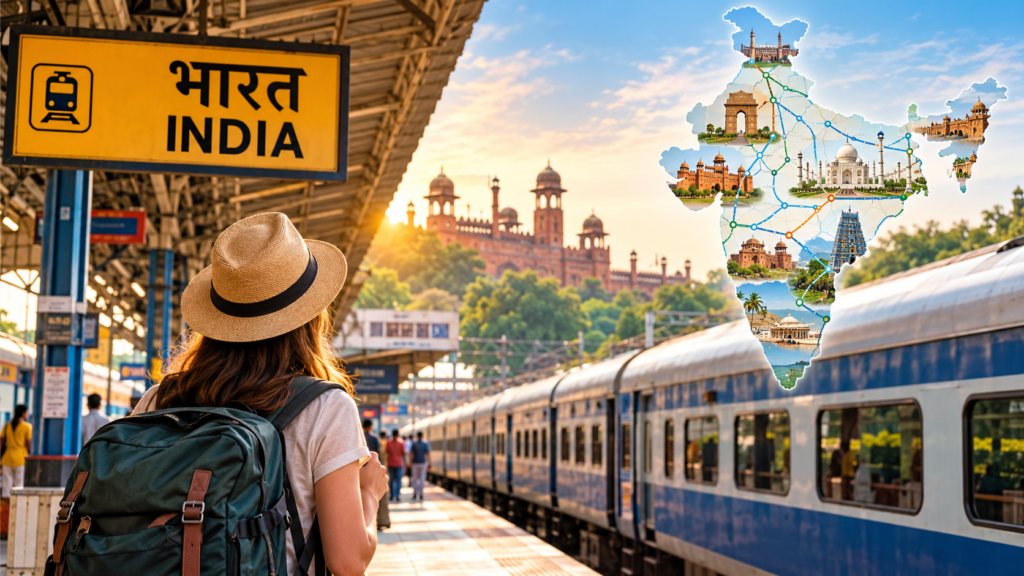
How to Book Train Tickets in India: A Complete Guide for Foreign Travellers
Understanding Train Travel in India
For a first-time traveller to India, booking a train ticket can initially feel a little confusing. India has one of the world’s largest railway networks, and with several train types, travel classes and booking options available, it is important to understand the basics before making your reservation.
The good news is that once you understand how the system works, travelling by train in India becomes relatively straightforward—and can be one of the most rewarding ways to experience the country.
India by Train: An Overview
India is extensively connected by rail, with an enormous network linking major cities, towns and many of the country’s most popular tourist destinations. While some remote areas, particularly deep within the Himalayan and other mountainous regions, have limited or no railway connectivity, most of India’s major tourist circuits can be comfortably explored by train.
For international travellers, Indian train journeys can broadly be divided into day journeys and longer overnight journeys.
The type of train and the class you should choose largely depends on the duration of your journey.
For example, a journey of a few hours during the day is generally more comfortable in a Chair Car or Executive Chair Car, while a longer overnight journey is better suited to one of the air-conditioned sleeper classes.
1. Understanding the Different Classes on Indian Trains
One of the first things you will notice when searching for an Indian train is the number of different classes available.
Depending on the train, you may see options such as:
-
Executive Chair Car (EC)
-
Chair Car (CC)
-
First AC (1A)
-
Second AC (2A)
-
Third AC (3A)
-
Sleeper Class (SL)
At first, these abbreviations can seem confusing. The easiest way to understand them is to separate them into seated day-travel classes and sleeper classes for longer journeys.
Chair Car (CC)
Chair Car is an air-conditioned seated class, primarily found on daytime trains.
Seats are arranged in a similar way to those you would expect on a comfortable intercity train. It is a practical choice for shorter journeys where you do not need a sleeping berth.
For example, on popular tourist routes such as Delhi–Agra or other daytime intercity journeys, Chair Car can be a comfortable option.
Executive Chair Car (EC)
Executive Chair Car is the more premium version of Chair Car.
You get more spacious seating and a more comfortable layout, making it suitable for travellers who prefer a higher level of comfort during a daytime journey.
A simple way to understand the difference is to think of it somewhat like the difference between second class and first class on European railways—although the exact seating configuration and services vary from train to train.
Sleeper Classes for Overnight Journeys
When you start looking at longer Indian train journeys, particularly overnight journeys, you will see a different set of classes.
The principal options are:
Sleeper Class → 3AC → 2AC → 1AC
The major differences are air conditioning, privacy, space and the number of passengers sharing the accommodation.
Sleeper Class (SL)
Sleeper Class is the traditional non-air-conditioned sleeper accommodation and is widely used by budget-conscious Indian travellers.
It consists of open sleeper bays with multiple berths. During the day, the berths can be used as seating, while at night they are converted into sleeping berths.
Sleeper Class is an authentic way to experience long-distance Indian train travel, but for a first-time international visitor, particularly on an overnight journey, it may not provide the level of comfort and privacy they are accustomed to.
For most foreign travellers, I would generally recommend considering an air-conditioned class for overnight journeys, particularly during warmer months.
Third AC (3AC)
Third AC, commonly referred to as 3AC, is an air-conditioned sleeper class and is one of the most popular options for long-distance travel in India.
It provides sleeping berths within an air-conditioned coach and offers a good balance between comfort and price.
There are more berths within each compartment compared with the higher classes, so the accommodation is more open and has less privacy than 2AC or 1AC.
For travellers looking for a comfortable overnight train experience without choosing the most expensive class, 3AC can be a practical option.
Second AC (2AC)
Second AC, or 2AC, offers a more spacious and comfortable experience than 3AC.
The sleeping arrangement provides fewer berths within each section, giving passengers more personal space. Curtains are also provided in the sleeping areas on many services, offering additional privacy.
For international travellers taking a longer overnight journey, 2AC is often a comfortable middle ground between price, privacy and comfort.
First AC (1AC)
First AC, or 1AC, is the premium accommodation available on many long-distance Indian trains.
Instead of an open arrangement with several passengers, First AC generally provides more private compartments or cabins, with fewer passengers sharing the space.
Depending on the train, you may find two-berth or four-berth compartments.
If privacy and comfort are your priorities, particularly for a long overnight journey, First AC is the most premium option among the conventional Indian Railways classes.
Which Train Class Should a First-Time Traveller Choose?
There is no single class that is right for everyone. Your choice should depend on the duration of your journey, your budget, the level of comfort you prefer and whether you are travelling during the day or overnight.
As a general guide:
Short daytime journey:
Chair Car (CC) or Executive Chair Car (EC)
Overnight journey with good value:
Third AC (3AC)
Long overnight journey with greater comfort and privacy:
Second AC (2AC)
Premium overnight experience:
First AC (1AC)
For a first trip to India, I recommend looking beyond the ticket price and considering the overall travel experience. A slightly higher class on a 10-hour overnight journey can make a significant difference to your comfort.
One Important Tip Before You Book
Don’t choose a train simply because it is the cheapest or because the departure time looks convenient.
Before booking, look at the train type, journey duration, departure and arrival stations, class, boarding point and arrival time.
India’s railway system is extensive, but it can be very different from the rail systems many international travellers are familiar with. Understanding these basics before booking will help you choose the right train and make your journey considerably more comfortable.
And once you get comfortable with the system, travelling by train becomes more than just a way of getting from one destination to another—it can be an integral part of experiencing India.
2. Check Your Railway Station Carefully
One of the most important things to check before booking an Indian train ticket is the railway station.
Unlike some countries where a city may have one main railway station, many Indian cities have multiple railway stations, and not every train operates from every station.
Therefore, when searching for a train, don’t simply enter the name of the city. Always check the exact departure and arrival station.
Delhi is a good example
Delhi has several major railway stations, including:
-
New Delhi Railway Station (NDLS)
-
Delhi Junction (DLI)
-
Hazrat Nizamuddin Railway Station (NZM)
These stations are all within Delhi, but they serve different train services and routes.
For example, if you are travelling from Delhi to Agra, the most suitable train for your itinerary may depart from New Delhi, while another convenient service may depart from Hazrat Nizamuddin.
Therefore, when comparing trains, consider not only the departure time but also:
-
Which railway station the train departs from
-
Where the train arrives
-
How far the station is from your hotel
-
How you will reach the station
-
Whether the station is convenient for your onward journey
A good train is not necessarily the one with the earliest departure or the lowest fare—the most convenient station can make a significant difference to your overall travel experience.
3. Look at the Train Type and Journey Time
India has a wide variety of trains, ranging from conventional long-distance services to newer, faster trains designed for comfortable daytime travel.
One of the newer train services that international travellers may come across is Vande Bharat Express.
These modern trains offer a more contemporary travel experience, with comfortable airline-style seating, good legroom and modern onboard facilities. They operate primarily on daytime routes, although services and schedules vary by sector.
For travellers planning journeys between major cities, it is worth checking whether a Vande Bharat service operates on your route.
However, don’t choose a train purely because it is newer or faster. Look at the complete journey:
Departure time + railway station + journey duration + arrival station + your onward travel plans.
Sometimes a slightly slower train from a more convenient station can actually be the better choice for your itinerary.
4. Book Your Train Tickets in Advance
India has a very large population of people who travel by train, and popular services can fill up quickly.
For regular advance reservations, Indian Railways generally opens bookings 60 days before the date of travel. This means that for popular routes, particularly during holidays and peak travel periods, it is advisable to plan your train journeys well in advance.
This is particularly important if you are travelling on popular tourist routes or have a fixed itinerary where changing your travel date is difficult.
What about foreign travellers?
International visitors may also find a Foreign Tourist Quota on selected trains and routes.
However, this facility is not available on every train or every sector, and availability and booking rules can change. Therefore, foreign travellers should check the current official information when planning their journey.
If you are travelling during a busy period, don’t leave your train booking until the last minute simply because flights or hotels are still available.
5. Enter Your Passport Details Carefully
Foreign travellers should pay particular attention when entering their name, nationality and passport details during the booking process.
Your passenger details should match your passport as closely as the booking system allows.
One issue that occasionally causes confusion is the length of a traveller’s name.
Some international travellers have three or four names, while the booking system may have limitations on the number of characters or words that can be entered.
If the booking system does not accept your complete name, enter the information accurately within the format and character limits permitted by the system. Do not deliberately change or shorten your name in a way that could make it inconsistent with your passport.
Always make sure that your passport number and other identification details are entered correctly, and carry the same passport with you during your journey.
If a ticket displays an abbreviated version of a long name because of the booking system’s character limitations, keep your passport and booking confirmation together so that the railway staff can verify your identity if required.
6. Understand CNF, RAC and Waitlist Before You Book
Another area that can be confusing for first-time visitors is the reservation status shown on an Indian train ticket.
You may see terms such as CNF, RAC or WL.
Understanding these terms before booking will save you a lot of confusion later.
CNF – Confirmed
CNF means Confirmed.
Your reservation has been confirmed and your seat or berth will be allocated to you.
Your coach and berth details will generally be shown on the ticket once the reservation is fully confirmed.
RAC – Reservation Against Cancellation
RAC means Reservation Against Cancellation.
An RAC passenger is permitted to travel, but the passenger may initially have a shared seating arrangement rather than a fully allocated sleeping berth.
As cancellations occur, RAC passengers may receive a full berth depending on availability and the final allocation.
For an international traveller, the important point is:
RAC is not the same as a waitlisted ticket—you are permitted to travel.
WL – Waitlisted
WL means Waitlisted.
A waitlisted ticket means that your reservation has not yet been confirmed.
For example, you may initially receive WL 50. If passengers cancel their reservations, your position may move to WL 40, WL 30 and so on.
However, a lower waitlist number does not guarantee that your ticket will eventually become confirmed.
If your ticket remains waitlisted, the applicable rules regarding cancellation/refund depend on the type of ticket and booking channel. Therefore, always check the current Indian Railways/IRCTC terms applicable to your booking.
7. Keep Checking Your PNR Status
Once you have booked your ticket, your journey is not necessarily finished from a planning perspective.
Keep your PNR (Passenger Name Record) number and check the reservation status closer to your travel date.
Your status can change from:
WL → RAC → CNF
or remain waitlisted depending on cancellations and availability.
For an international traveller with a fixed itinerary, I recommend checking the status before leaving for the railway station and confirming your coach and berth details.
A Simple Rule for First-Time Visitors
When booking an Indian train, don’t look at the ticket price alone.
Instead, consider these five things together:
1. Which railway station?
2. Which train?
3. Which class?
4. Is the reservation confirmed?
5. Does the timing fit your overall itinerary?
Once you understand these five points, booking trains in India becomes much less complicated.
India’s railway system can initially appear overwhelming, but with a little preparation, it can be a comfortable, efficient and memorable way to travel between many of the country’s major destinations.